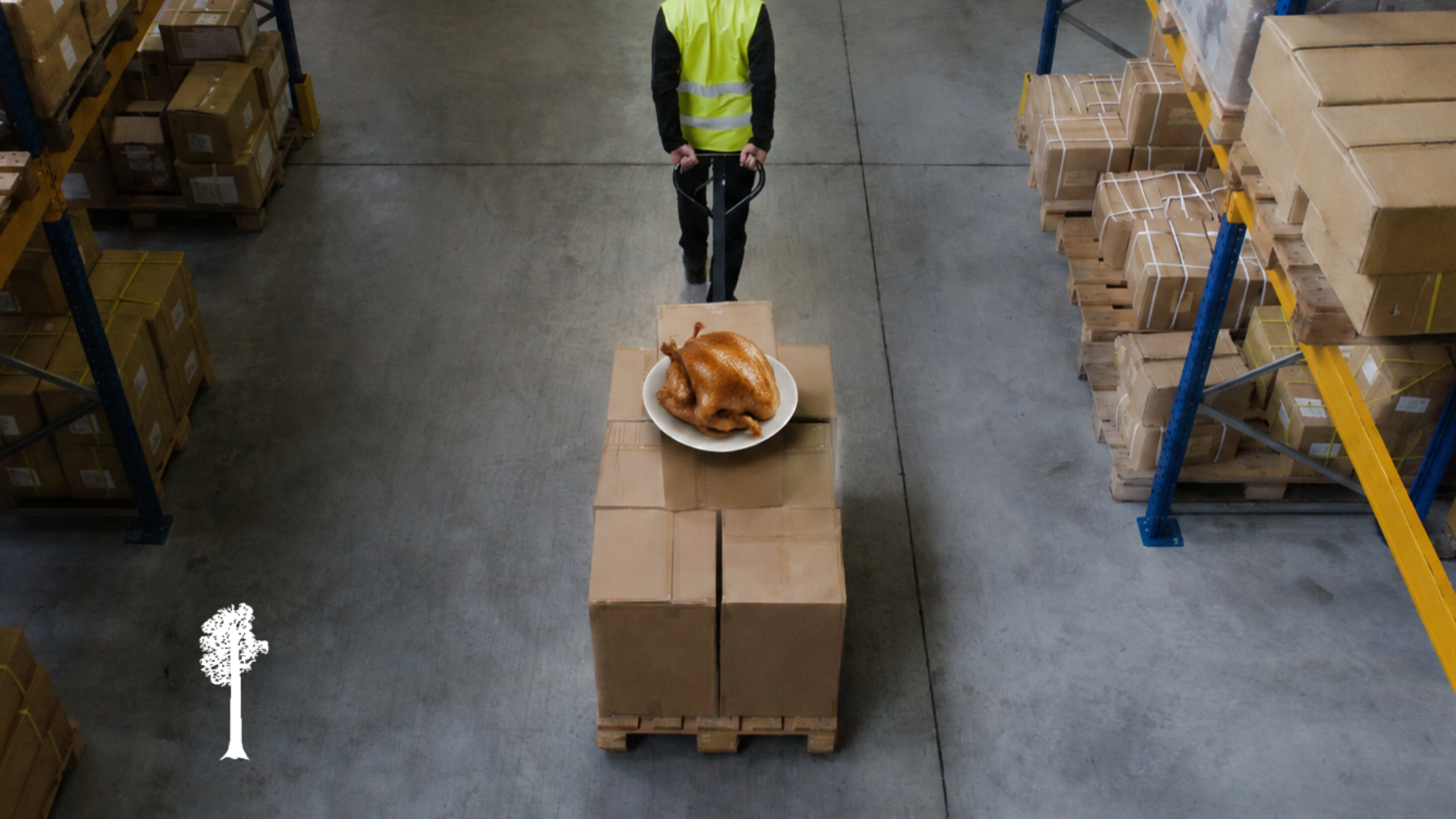
This Thanksgiving, we’re taking a moment to appreciate how warehouse technology has evolved, the improvements that make distribution more efficient, and the people who keep everything moving.
There’s a Lot That Happens Before Thanksgiving Dinner
When we sit down for Thanksgiving dinner, we rarely think about everything it took to get that meal on the table.
The products that needed to be manufactured. The inventory that had to be received. The warehouse teams that picked and shipped the orders. The drivers who made the deliveries. And the retailers who made sure everything was available when customers needed it.
Most people never see that work.
But those of us in distribution know how much effort happens behind the scenes.
As Thanksgiving approaches, we thought it might be worth taking a moment to appreciate something we don’t often stop to consider.
Just how far this industry has come.
Technology has changed nearly every aspect of distribution management over the past several decades. And while there will always be new challenges to solve, it’s worth recognizing how much easier, more accurate, and more manageable many everyday responsibilities have become.
Not because technology does everything for us.
But because the right technology helps good people do their jobs better.
Remember When Everything Required a Clipboard?
There was a time when knowing what was in the warehouse meant checking paperwork, reviewing inventory records, making phone calls, or walking the floor.
Receiving was recorded manually. Inventory counts relied heavily on paper. Finding an item could require someone who simply knew where everything was.
And correcting a mistake often meant tracking down the person who knew what happened.
One of the earliest steps toward changing that came in 1974, when the first commercial Universal Product Code (UPC) was scanned at a supermarket in Ohio.
A pack of Wrigley’s chewing gum became a small but significant milestone in the history of inventory and product identification.
More than 50 years later, barcode scanning, mobile devices, warehouse management systems, and integrated business software have transformed how products move through the supply chain.
Today, a properly configured WMS can direct employees to the correct locations, record inventory movements as they occur, and provide visibility that would have required considerable manual effort in earlier decades.
That’s progress worth appreciating.
Better Visibility Means Fewer Surprises
Perhaps one of the greatest improvements in distribution management is the ability to know what’s happening without having to go find out.
Modern ERP and warehouse management systems can help businesses see what inventory is available, where it is located, which orders are in progress, and where exceptions need attention.
For a convenience distributor managing thousands of products, or a 3PL handling inventory for multiple customers, that visibility can make an enormous difference.
It means customer service can provide better answers. Warehouse supervisors can recognize problems earlier. Leadership can make decisions using more current information.
The technology isn’t perfect, and the information is only as reliable as the processes supporting it.
But consider the alternative.
It’s difficult to make a good decision when you don’t know what’s happening.
Better visibility doesn’t eliminate every problem. It gives people a better opportunity to solve problems before they become bigger ones.
And that’s something both employees and customers benefit from.
We’re Asking Less of Memory and More of the System
Ask an experienced warehouse employee how much their job has changed over the years.
They’ll likely have a few stories.
There was a time when the success of an operation depended heavily on people remembering locations, knowing workarounds, and understanding processes that weren’t always documented.
Experience still matters tremendously.
But today, system directed workflows, barcode verification, and more consistent operating procedures can help employees complete their work with greater confidence.
Instead of relying entirely on memory, employees can receive clear instructions about what to pick, where to go, and what to verify.
New team members can become productive with more consistent training and guidance. Experienced employees can spend less time correcting preventable mistakes.
The objective isn’t to remove human judgment.
It’s to reserve human judgment for the situations that actually need it.
That’s an important distinction.
Automation Is Giving People New Ways to Work
The evolution hasn’t stopped at software.
Warehouse automation and robotics are changing how products are stored, moved, picked, and prepared for shipment.
And artificial intelligence is beginning to create opportunities to reduce repetitive administrative work, improve access to information, and support operational decisions.
Not every warehouse needs robotics. Not every process benefits from AI.
But the opportunity to reduce unnecessary effort is real.
According to the 2026 MHI Annual Industry Report, 58% of surveyed supply chain leaders identified talent acquisition and workforce challenges as a leading concern.
That makes the relationship between people and technology especially important.
When technology can reduce repetitive tasks, minimize unnecessary travel, or simplify complicated workflows, employees have more opportunity to focus on work that requires their experience and attention.
Done thoughtfully, automation isn’t simply about moving more product with fewer resources.
It’s about helping people work more effectively while building an operation that can support continued growth.
That’s a meaningful improvement.
We Can Measure What We Used to Guess
Another advancement worth recognizing is how much more information distribution leaders have available today.
Warehouse performance once depended heavily on periodic reports, manual calculations, and observations made after the work was complete.
Today, businesses can monitor order accuracy, inventory discrepancies, dock activity, labor productivity, and shipping performance with much greater frequency.
In fact, the 2026 Warehouse/DC Operations Survey published by Supply Chain Management Review found that 93% of surveyed warehouse operations use some form of performance metrics.
That doesn’t mean every organization has perfect reporting.
It means there are more opportunities than ever to understand where time, money, and effort are being spent.
And when that information is accurate and accessible, it can lead to better decisions.
The question becomes less about how busy the warehouse is and more about how well the operation is performing.
That’s a valuable shift.
Of Course, We Still Have Work to Do
Being grateful for progress doesn’t mean pretending every warehouse is running perfectly.
That same 2026 Warehouse/DC Operations Survey found that 84% of respondents use some form of WMS, yet 55% reported using paper based picking methods in at least part of their operations.
It’s a good reminder that adopting technology and fully realizing its benefits are two different things.
Distributors still face disconnected systems, inventory inaccuracies, labor constraints, manual workarounds, and increasing customer expectations.
Technology continues to evolve, and so do the demands placed on the businesses using it.
But we have better tools, more experience, and a greater understanding of what effective distribution operations require.
The opportunity now is to put those advantages to work.
Not by chasing every new technology.
But by identifying the processes that need improvement and choosing solutions that make the operation better.
Most of All, We’re Thankful for the People
For all the advances in software, robotics, and automation, there’s something that hasn’t changed.
Distribution is still a people business.
It’s the warehouse employee who notices an inventory discrepancy before it affects a customer. The supervisor who finds a better way to organize the day’s work. The technology professional who resolves a problem before the next shift begins.
It’s the drivers, customer service teams, managers, and business owners who keep everything moving, particularly during the busiest weeks of the year.
Technology can support their work.
But it doesn’t replace their dedication, judgment, or experience.
As we approach Thanksgiving, there’s a practical opportunity for every distribution leader: take a moment to recognize the people who keep the operation running, and ask what would make their jobs easier in the coming year.
Then listen.
Some of the best operational improvements begin with a simple conversation.
A Moment to Appreciate the Progress
At Sequoia Group, we’ve had the privilege of working alongside distributors and logistics providers for more than 30 years.
We’ve watched technology change, businesses grow, and the expectations placed on warehouse operations become increasingly complex.
Through it all, one thing has remained consistent.
The best technology is the technology that helps people and businesses succeed.
Whether that’s improving inventory visibility, simplifying a warehouse workflow, connecting business systems, or eliminating unnecessary manual work, the objective has always been about more than software.
It’s about making the operation work better.
This Thanksgiving, we’re grateful for the progress our industry has made, the customers and partners who continue to place their trust in us, and the hardworking people who make distribution possible every day.
There’s plenty more to accomplish.
But every once in a while, it’s worth recognizing how far we’ve come.
From all of us at Sequoia Group, Happy Thanksgiving.
And thank you to the people behind every delivery.
Learn more about how Sequoia Group helps distributors improve their operations.